
How Do Credit Cards Work? The Free Window And The Costly One
Money basics explained visually. How do credit cards work? Watch the statement.
Every number below is an invented example, and every claim is checked against a primary source - you can see the sources at the end.
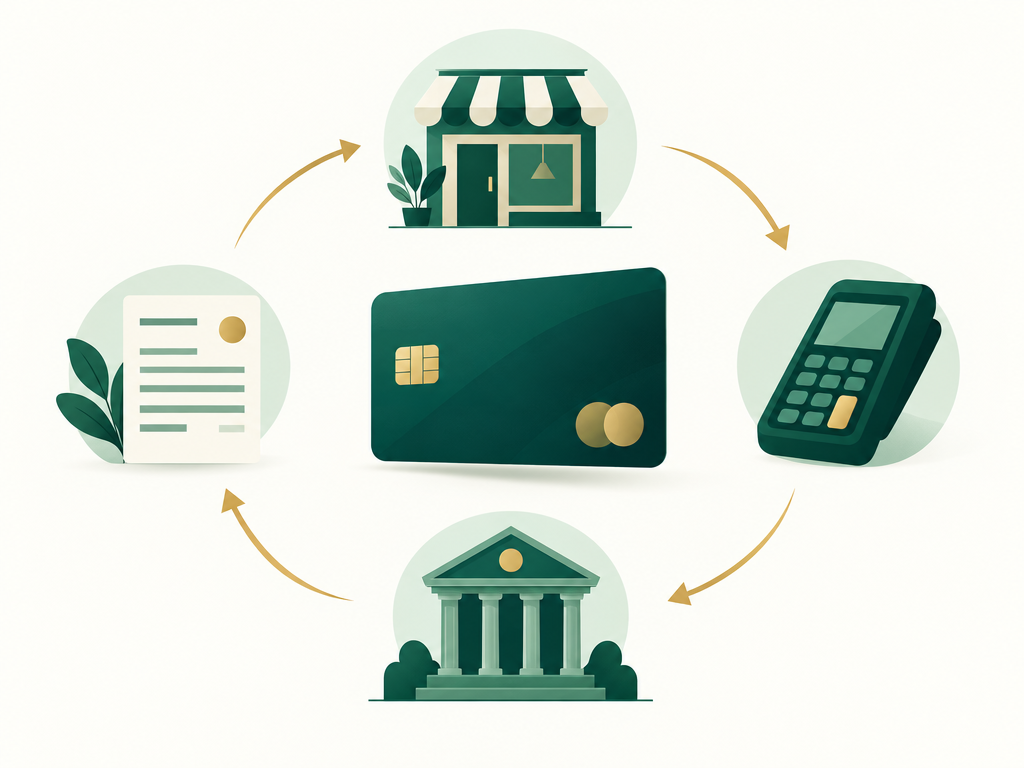
Ask "how do credit cards work?" and most people picture the plastic: tap, swipe, done. But the real answer is hiding in a piece of paper (or a screen) that most people barely read: your statement. Every statement opens a window of time. One window can be free. The other costs.
Before we start, one quick note: every rule in this post is US federal law. Let's go through it piece by piece.
First, the card is just a key to a credit line
US law has a formal name for a credit card account: an open-end credit account. It sounds technical, but the idea is simple. It's a reusable credit line, and the card is just how you reach it.
Say you buy groceries with the card. That purchase draws down part of your line. When you repay it, that part of the line frees up again, ready to be used.
Think of it like a water jug you can drink from and refill, over and over. Draw, repay, draw again. That loop is exactly what "open-end" means.
The statement starts a clock
Every credit line has a clock running behind it, and that clock is the statement. Each period, a statement is mailed or delivered to you. Ahead of it sits the payment due date.
US law sets a gap between those two moments. There must be at least 21 days from the statement to the due date. That rule comes from the CARD Act.
The statement also names a second date: the date your grace period ends. That date has its own 21-day rule. The statement must be sent at least 21 days before the grace period ends. So you get time to see the statement before either date arrives.
The free window: what a grace period is
A grace period is a span of time to repay. Any part of the balance you repay inside it comes with no additional finance charge. In plain English, nothing extra gets added on top for that part.
On your statement, the grace period shows up as a date or a period. If the new balance is paid by then, it avoids those additional finance charges.
Here's an example. Imagine your statement shows a new balance made up of a few purchases. If that new balance is repaid by the grace period date, those purchases are inside the free window.
But here's the catch: a grace period is not automatic. The rule says "if one is provided." A plan may offer one, or it may not. So whether the free window exists at all depends on the plan.
The costly window, and the warning on your statement
Now say the balance isn't cleared. The grace period date comes, and then it goes. Whatever is still unpaid isn't covered anymore.
The free window has closed on that leftover amount. From here on, it sits in the costly window.
This is why the statement has to carry a warning. It's called the Minimum Payment Warning, and the law requires it to be there. It says that paying only the minimum means you pay more in interest, and it takes longer to pay off.
The statement must also show two estimates. The first is how long payoff takes if you only make minimum payments. The second is the total cost of paying that way. We won't invent those numbers here, because they're different for everyone. Your own statement is where they appear.
Where your payment goes, and when it counts
A card can carry balances at different rates. Picture them as a stack of blocks, with the highest rate sitting on top.
Say part of your balance is at a higher rate and part is at a lower rate. Anything paid above the minimum follows a rule. It must go to the balance with the highest annual percentage rate first. So the top of the stack shrinks first.
Timing has a rule of its own. The clock starts when the statement is mailed or delivered, and 21 days run from that moment. Picture a required minimum payment received inside those 21 days. That payment cannot be treated as late.
Both of these are written rules: the order a payment is applied in, and the timing that decides whether it counts as on time.
Putting it all together
So, how do credit cards work? Like this. A credit line you draw on and repay. A statement that starts a 21-day clock.
A free window, if the plan provides one. A costly window for whatever is left over. And a warning, printed right on the statement, that paying only the minimum costs more.
The grace period date is what decides which window a balance falls into. These are US federal rules only, and this post shows you the window, not the price. What you do with it is your call.
Sources
Each statement in the film was checked against its own source before it was made:
- A credit card account is an open-end consumer credit plan: a credit line you draw against, repay and draw against again - ecfr.gov
- The card issuer must mail or deliver the periodic statement at least 21 days before the payment is due - govinfo.gov
- A grace period is something the plan MAY provide - it is not automatic - ecfr.gov
- In a grace period the balance can be repaid without an additional finance charge - govinfo.gov
- On the statement, the grace period is the date or time period by which the new balance must be paid to avoid additional finance charges - ecfr.gov
- Where a grace period applies, the statement must be sent at least 21 days before that period expires - ecfr.gov
- The statement must carry a Minimum Payment Warning: paying only the minimum means more interest and a longer payoff - ecfr.gov
- The statement must show an estimate of how long the balance lasts if only minimum payments are made - ecfr.gov
- The statement must show an estimate of the total cost of paying that way - ecfr.gov
- A payment above the required minimum must be applied first to the balance with the highest annual percentage rate - ecfr.gov
- A required minimum payment received within 21 days after the statement was mailed or delivered must not be treated as late - ecfr.gov
What this is not
This is an explanation of a money mechanic, not financial advice. There are no recommendations, no products, no predictions, and no promise about what any amount of money will do. The film shows the arithmetic of a rule that has been used for a long time; what you do with it is your own decision.
Watch it
This post accompanies the film: How Do Credit Cards Work? The Free Window And The Costly One
Sources checked at time of publication. Educational content only - never financial advice.
Try it yourself: the compound interest calculator runs this arithmetic on numbers you type — what goes in, what the growth adds, year by year. No forecast, no advice, just the maths.