
What Is A Budget? A Plan Made Before The Month Starts
Money basics explained visually. What is a budget? Here is the mechanic.
Nothing below is a calculated guess: every claim is checked against a primary source before it is made - you can see the sources at the end.
Ask people what is a budget and you'll usually get one of two pictures. Many people picture a list of what they've already spent. Others picture a limit that someone else sets for them. The FDIC sees it differently: a budget is an organized plan that helps you keep track of how much money you earn, how much you spend and how much you've saved. So it looks forward, not just back. Here is how it works.
The three parts of every budget
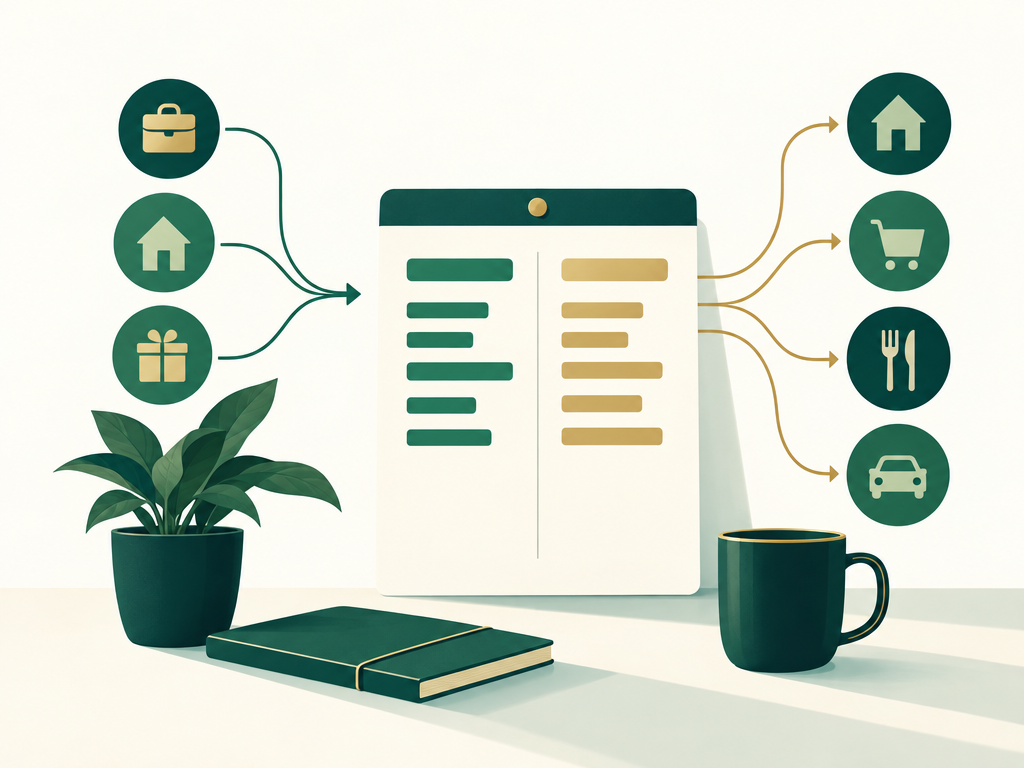
A budget typically has three parts: income, expenses and savings. Income is the money coming in. Expenses are the money going out. Savings is what you set aside.
Seeing all three together is where a budget earns its keep. It puts your income and expenses in one place, so you're not juggling half the picture in your head. From there, a budget helps you decide how much you can afford to spend, and how much to save for short-term and long-term goals.
The first step in building one is gathering all your financial information. You can't plan around money you haven't counted.
Income: the money coming in
Your income is the money you receive on a regular basis. Usually it comes from an employer. It can also come from investments, or from retirement benefits like a pension, social security or disability.
There's an important difference to know here. Gross income is your earnings before taxes and other deductions. Net income is your take-home pay, meaning what's left after those come out. A budget is calculated on your net income, because that's the money you can actually spend.
What if your pay is different every time? The method is to average two to four pay stubs to work out your average take-home pay. That gives the plan a steady number to work from, even when your pay goes up and down.
Expenses: needs versus wants
Expenses are what you pay for the goods and services you need or want. A budget helps you keep track of which is which, and that turns out to matter a lot.
A need is something you can't live without. The FDIC's example is clothes. Paying rent or a mortgage also counts as a need, because you need a roof over your head.
A want is something you'd like to have but can live without. Dining out is the classic example, and wants like that can add up without you noticing. Comparing your choices helps you decide which item matters more. Either way, your purchases have to fit within your budget.
Savings: planned, not leftovers
The next step is simple subtraction: take your expenses away from your income. Any money left over can be saved. If your income can't cover your expenses, you need to make choices.
Once a budget is done, it shows you clearly where you stand. You can see whether you had money left over each month or came up short. It might show that you kept up with your expenses but had little left over for emergencies. Adding up your income and expenses gives you a clear picture of your current financial situation.
Here's the twist that surprises a lot of beginners. Savings is one of the three parts of the budget, so it's planned in from the start. It isn't just whatever happens to be left at the end. A budget makes it less likely that you overspend and live beyond your means, and more likely that you live within your income.
Saving typically won't make you rich. But it can help you be ready for the financial surprises that are bound to come. A modest emergency fund helps absorb the impact of some of those costs. And it isn't about how much you save. It's about starting the habit, and habits take time to learn and stick with.
How people keep a budget going
Committing to a budget means having a strategy for spending within your means, and then sticking to it. A plan you write once and forget isn't doing much.
That's where a monthly check-in comes in, either on your own or with your family. It's a look back over your budget and your spending habits. The point is to see whether you're sticking to the plan or whether the plan needs adjusting.
People use different tricks to stay on track. Some keep separate checking accounts, one for bills and one for everyday spending. Others use cash for miscellaneous expenses. When the cash runs out, that's a physical signal that they're about to step outside their budget.
The same word at national scale
Governments use the word "budget" too, and in the United States, federal law sets a timetable for it. On the first Monday in February, the President submits a budget. By February fifteenth, the Congressional Budget Office reports to the Budget Committees.
Congress completes action on the budget resolution by April fifteenth. From May fifteenth, the House may consider annual appropriation bills. Congress completes reconciliation by June fifteenth, and the federal fiscal year begins on October first.
That timetable is United States federal law. Your own budget works on a much smaller scale. So if anyone asks you what is a budget, the short answer is a plan you keep: income, expenses and savings, plus a monthly check-in to keep it honest.
Sources
Each statement in the film was checked against its own source before it was made:
- A budget is an organized plan that can help you keep track of how much money you earn, how much you spend, and how much you have saved - fdic.gov
- Having a budget or a plan can help you with your savings goals - fdic.gov
- A budget can help us keep track of what we want and what we need - fdic.gov
- A budget typically has three parts: income, expenses, and savings - fdic.gov
- A budget will help you decide how much money you can afford to spend - fdic.gov
- A budget can help you determine how much money you have to save for short-term and long-term goals - fdic.gov
- Budgeting helps you keep track of what money is coming in and what is going out of your pocket, which is your income and your expenses - mycreditunion.gov
- Having a budget allows you to have a clear view of your income and expenses all in one place - mycreditunion.gov
- Having a budget is crucial to managing your money, staying out of debt, and ultimately building wealth - mycreditunion.gov
- Income is the money you receive from jobs, allowances, and other sources - fdic.gov
- Your income is the money you receive on a regular basis - mycreditunion.gov
- Income typically comes from an employer, but it can also come from investments and from retirement benefits like a pension, social security or disability - mycreditunion.gov
- The first step to developing a budget is gathering all your financial information - mycreditunion.gov
- Gross income represents your earnings before taxes and other deductions - mycreditunion.gov
- Net income is your take-home pay after taxes and deductions - mycreditunion.gov
- A budget is calculated based on your net income - mycreditunion.gov
- If your income fluctuates, you average two to four pay stubs to calculate your average take-home pay - mycreditunion.gov
- A budget makes it less likely that you overspend and live beyond your means - mycreditunion.gov
- A budget makes it more likely that you live within your income - mycreditunion.gov
- Expenses are the cost of goods and services of the needs or wants you spend your money on - fdic.gov
- Expenses are the costs required for the items and services you use and depend on - mycreditunion.gov
- A need is something you cannot live without, like clothes - fdic.gov
- A want is something you would like to have but can live without - fdic.gov
- Paying for rent or a mortgage is a need, because you need a roof over your head - mycreditunion.gov
- Dining out is a want, and wants can add up - mycreditunion.gov
- Comparing choices can help you decide which item is more important to buy - fdic.gov
- Your purchases have to fit within your budget - fdic.gov
- When you subtract expenses from your income, any leftover money can be saved - fdic.gov
- If you do not have enough income to cover expenses, you need to make choices - fdic.gov
- After completing a budget you can see whether you had money left over each month, or whether you came up short - mycreditunion.gov
- A budget can show that you kept up with expenses but had little left over for emergencies - mycreditunion.gov
- Adding up your income and expenses gives you a clear illustration of your current financial situation - mycreditunion.gov
- Income, expenses and savings are the three parts, so the savings part is planned, not whatever is left - fdic.gov
- Committing to a budget means having a strategy for spending within your means and sticking to it - mycreditunion.gov
- A monthly check-in with yourself or your family reviews your budget and your spending habits - mycreditunion.gov
- The check-in helps you assess whether you are sticking to your budget or need to readjust it - mycreditunion.gov
- Some people find it helpful to have separate checking accounts for bills and miscellaneous spending - mycreditunion.gov
- Some people use cash for miscellaneous expenses, so running out of physical money shows they are stepping outside their budget - mycreditunion.gov
- Saving is one of the most basic ways consumers can set themselves up for financial success - mycreditunion.gov
- Saving typically does not make you rich, but it can help you be prepared for inevitable financial surprises - mycreditunion.gov
- A modest emergency fund helps absorb the impact of some costs when they come up - mycreditunion.gov
- Saving is not about how much you save, it is about starting the habit - mycreditunion.gov
- Building a habit takes time to learn and commit to - mycreditunion.gov
- US federal law sets a timetable for the congressional budget process for any fiscal year - law.cornell.edu
- Under that timetable the President submits his budget on the first Monday in February - law.cornell.edu
- The timetable names the first Monday in February as the date the President submits his budget - law.cornell.edu
- The Congressional Budget Office submits its report to the Budget Committees by February fifteenth - law.cornell.edu
- Congress completes action on the concurrent resolution on the budget by April fifteenth - law.cornell.edu
- The timetable's April fifteenth entry is Congress completing action on the concurrent resolution on the budget - law.cornell.edu
- Congress completes action on reconciliation legislation by June fifteenth - law.cornell.edu
- The federal fiscal year begins on October first - law.cornell.edu
- The timetable's October first entry is the fiscal year beginning - law.cornell.edu
- Annual appropriation bills may be considered in the House from May fifteenth - law.cornell.edu
What this is not
This is an explanation of a money mechanic, not financial advice. There are no recommendations, no products, no predictions, and no promise about what any amount of money will do. The film shows the arithmetic of a rule that has been used for a long time; what you do with it is your own decision.
Watch it
This post accompanies the film: What Is A Budget? A Plan Made Before The Month Starts
Sources checked at time of publication. Educational content only - never financial advice.