
What Is A Tariff? A Tax At The Border
Money basics explained visually. What is a tariff? A tax at the border.
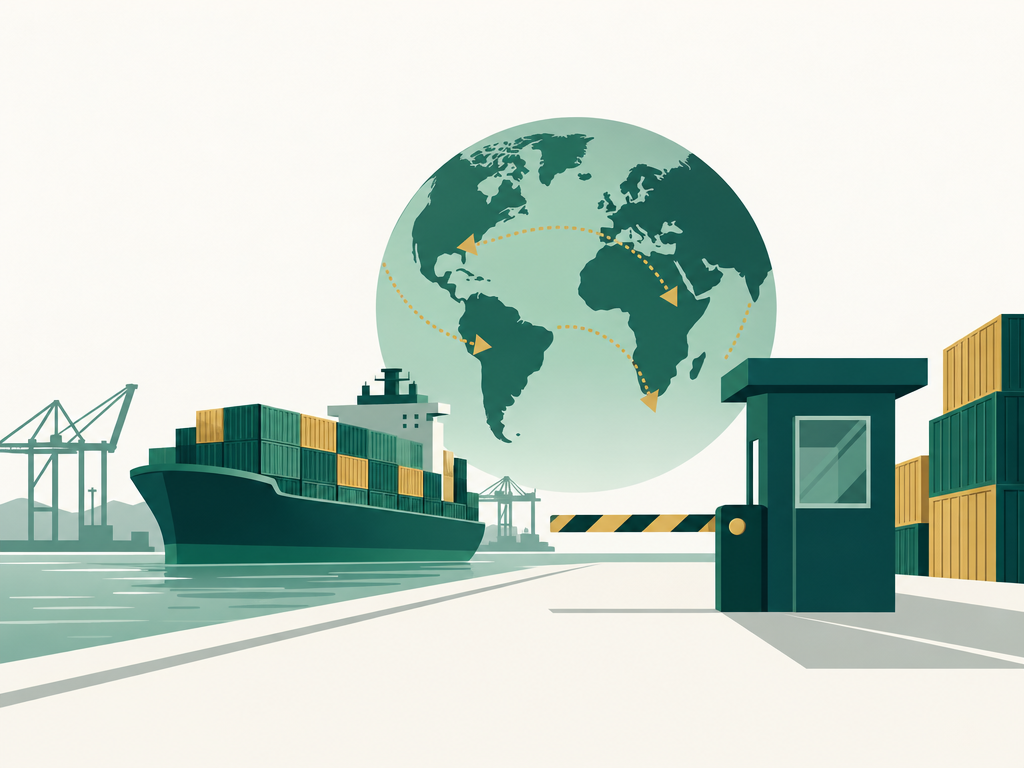
Nothing below is a calculated guess: every claim is checked against a primary source before it is made - you can see the sources at the end.
Ever heard a news story mention "tariffs" and nodded along, not quite sure what it meant? You're not alone. So, what is a tariff? Put simply, it's a tax at the border. When goods arrive from another country, the government can charge a fee on them, and that fee is the tariff.
A tax that waits at the border
The official name for a tariff is a customs duty. It's charged on imports, which are goods made in another country and brought in.
Picture a ship full of bicycles made overseas pulling into port. Before those bikes can reach the shops, customs steps in and says, "There's a duty to pay on these." That duty is the tariff.
The key word is imports. A tariff only applies to goods coming in from abroad, which is why it sits at the border.
How the amount is worked out
A tariff can be charged in either of these ways: as a percent of the goods' value, or as a fixed amount per unit. Each works a bit differently.
The percent-of-value way is called "ad valorem." The duty is a slice of what the goods are worth. Imagine a crate of fancy watches and a crate of cheap ones. Under this method, the fancy crate pays a bigger duty because it's worth more.
The fixed-amount way is called a "specific" tariff. Here, every item pays the same set charge, whatever its price. Think of a shipment of shoes. Cheap sneakers and expensive boots would each pay the same amount per pair.
Who actually pays it?
You might guess the foreign company selling the goods pays the tariff. In the US, that's not how it works. Importers pay, not exporters.
Under US customs law, the importer is the person mainly responsible for paying any duties on the goods. Say a shop owner in the US orders lamps from a factory abroad. The factory is the exporter, because it sends the lamps out. The shop owner is the importer, because they bring the lamps in. When the duty bill comes, customs looks to the shop owner.
Why governments use tariffs
Tariffs do two main jobs. The first is simple: they raise revenue. The money paid at the border goes to the government.
The second is a bit sneakier. Tariffs give locally made goods a price edge over similar imported goods. Go back to those bicycles. The imported bike picks up an extra cost at the border, but a bike made at home never crosses that border, so it never faces that duty. That's the price advantage for local producers.
Ceilings and the rates actually charged
Countries in the World Trade Organization (WTO) make a promise about their tariffs. They commit to a ceiling rate, the highest rate they'll charge. This is called "binding" their rates.
But the rate a country actually charges can sit lower than that ceiling. Think of a speed limit sign. It tells you the maximum, but you're still allowed to drive slower. The ceiling is the limit, and the real rate can be anywhere at or below it.
Putting it all together
So the next time someone asks you what is a tariff, you can tell them the whole story. It's a customs duty on imports, charged either as a percent of value or as a fixed amount per unit.
In the US, the importer pays it, not the exporter. It brings in money for the government and gives local producers a price edge. And WTO countries promise a ceiling rate, even though the rate they actually charge can be lower.
Sources
Each statement in the film was checked against its own source before it was made:
- A tariff is a customs duty charged on merchandise imports - wto.org
- A tariff gives locally produced goods a price advantage over similar imported goods - wto.org
- Tariffs raise revenue for governments - wto.org
- A tariff is levied either on an ad valorem basis (a percentage of value) or on a specific basis (a fixed amount per unit) - ustr.gov
- Under US customs law the importer is the person primarily liable for the payment of any duties on the merchandise - ecfr.gov
- WTO members bind their customs duty rates at ceiling levels, and the rate they apply can be lower than the bound rate - wto.org
What this is not
This is an explanation of a money mechanic, not financial advice. There are no recommendations, no products, no predictions, and no promise about what any amount of money will do. The film shows the arithmetic of a rule that has been used for a long time; what you do with it is your own decision.
Watch it
This post accompanies the film: What Is A Tariff? A Tax At The Border
Sources checked at time of publication. Educational content only - never financial advice.