
What Is The Federal Reserve? The Bank For Banks
Money basics explained visually. A bank can run short of cash by lunchtime.
Nothing below is a calculated guess: every claim is checked against a primary source before it is made - you can see the sources at the end.
Here's something that surprises most people: a bank can run short of cash by lunchtime. If you've ever typed "what is the federal reserve" into a search bar, this is the best place to start. Even banks need somewhere to borrow from, and in the US, that place is the Federal Reserve.
Wait, banks can run out of cash?
Picture a busy morning at your local bank branch. People are withdrawing money, businesses are paying bills, and cash keeps going out the door. By lunchtime, the bank may simply not have enough on hand.
That sounds scary, but it's a normal part of how banks work. Think of a corner shop that sells more than expected and runs low on stock before the delivery truck arrives. The shop isn't broken. It just needs a top-up, fast.
The bank for banks
When you need money, you might go to your bank. So where does your bank go? Even banks have a bank to borrow from.
In the US, that's the Federal Reserve. It's like the parent who keeps a spare key for the whole street. Most days nobody needs it, but when someone gets locked out, everyone knows where to go.
What the Federal Reserve actually does
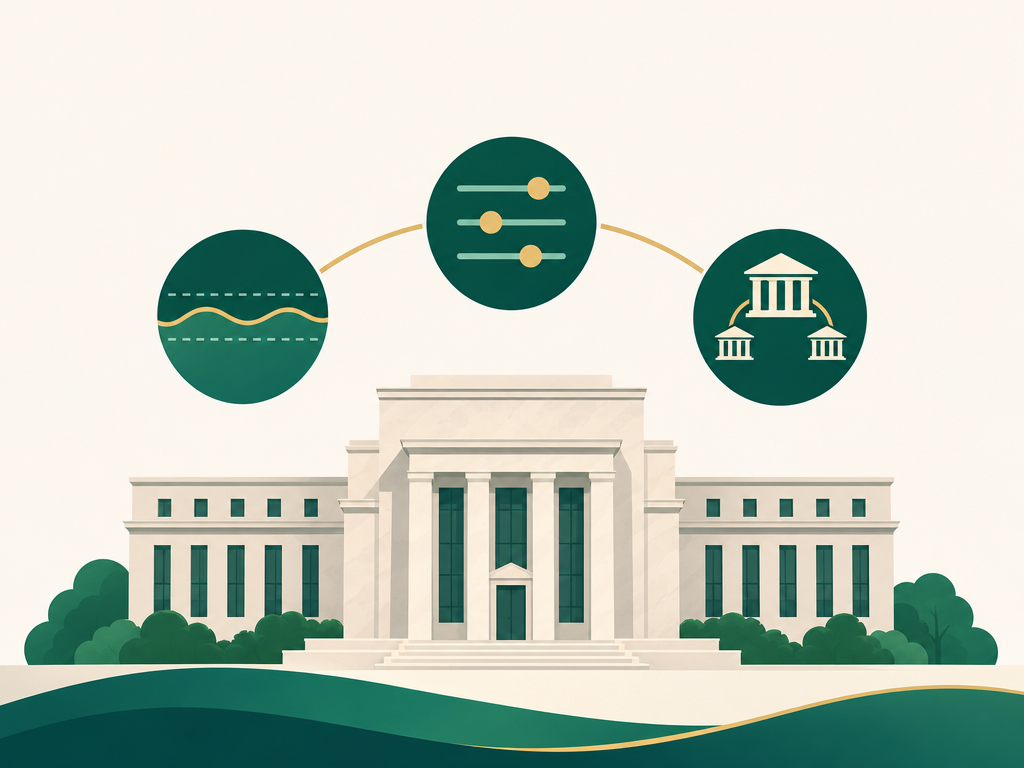
The Federal Reserve performs five general functions to help the U.S. economy run smoothly. You don't need to memorise them all to get the big picture. Let's focus on the one that comes up most.
That's monetary policy. It's aimed at two goals: maximum employment and stable prices. In plain English, that means as many people as possible having jobs, and the price of your groceries not jumping around wildly from month to month.
There's also a Board that sits at the top. It oversees the operations of the twelve Reserve Banks and shares with them the job of supervising banks. Think of it like a head office keeping an eye on its regional branches.
The discount window: where banks borrow
So how does a bank actually borrow from the Federal Reserve? It uses something called the discount window. Despite the name, it's not a shop counter with a sale sign. It's simply the way banks borrow from Federal Reserve Banks.
The twelve Reserve Banks operate the discount window. So when a bank runs short by lunchtime, this is the door it knocks on. Imagine a reliable friend who will lend you money for petrol, but only if you follow their rules.
Not a gift: the rules for borrowing
Here's the catch. A bank can't just walk up and ask for money. Borrowers must first sign legal agreements and pledge collateral.
Collateral is something valuable you promise to hand over if you don't pay the money back. It works a bit like a pawn shop: you leave your guitar on the counter, and you get it back when you repay the loan. The guitar is the lender's safety net.
That's why borrowing from the discount window is a secured loan, never a gift. The bank gets help when it needs it, but it has to put something real on the line first.
Putting it all together
Banks can run short of cash, sometimes by lunchtime. When that happens, they can borrow from the Federal Reserve through the discount window, run by the twelve Reserve Banks. And they only get that money after signing agreements and pledging collateral.
So the next time someone asks you "what is the federal reserve", you can tell them it's the bank that banks borrow from. It performs five general functions, works toward maximum employment and stable prices, and lends to banks only on a secured basis.
Sources
Each statement in the film was checked against its own source before it was made:
- The Federal Reserve performs 5 general functions to promote the effective operation of the U.S. economy - federalreserve.gov
- It conducts the nation's monetary policy to promote maximum employment and stable prices - federalreserve.gov
- The discount window allows depository institutions to borrow from Federal Reserve Banks - federalreserve.gov
- A bank borrowing at the window does so only after executing legal agreements and pledging collateral - federalreserve.gov
- The twelve Reserve Banks operate the discount window - federalreserve.gov
- The Board oversees the operations of the 12 Reserve Banks and shares with them the responsibility for supervising banks - federalreserve.gov
What this is not
This is an explanation of a money mechanic, not financial advice. There are no recommendations, no products, no predictions, and no promise about what any amount of money will do. What you do with the information is your own decision.
Watch it
This post accompanies the film: What Is The Federal Reserve? The Bank For Banks
Sources checked at time of publication. Educational content only - never financial advice.