
Why Are Gas Prices So High? What Actually Sets The Price At The Pump
Money basics explained visually. Why are gas prices so high?
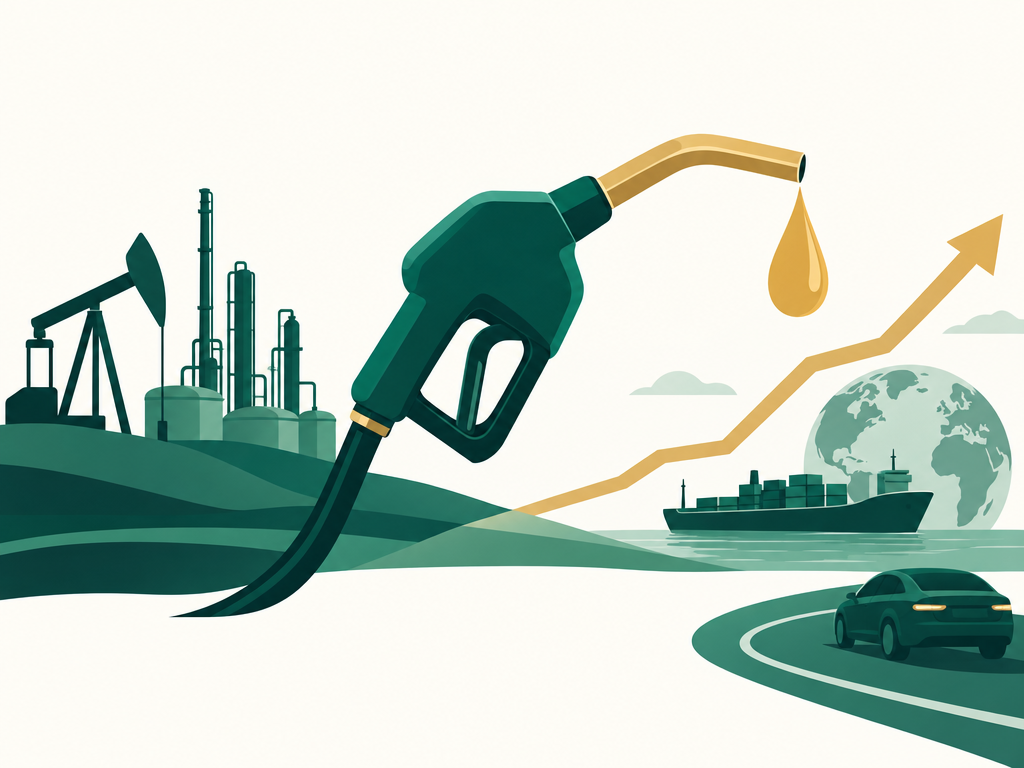
Nothing below is a calculated guess: every claim is checked against a primary source before it is made - you can see the sources at the end.
You've probably stood at the pump, watched the numbers spin, and typed "why are gas prices so high" into your phone. Here's the surprise: you aren't paying for one thing when you fill up. You're paying for four things at once. Once you can see those four pieces, the price on the big sign starts to make sense.
Your gas price is really four prices stacked together
Think of a pizza. You pay one price, but that price covers the dough, the cheese, the oven and the delivery driver. Gas works the same way.
The price of a gallon of gasoline (petrol, if you're in the UK or Australia) covers four things: the crude oil, the taxes, the cost of refining (plus the refiner's profit), and the cost of getting the fuel to you and selling it. Each piece can move on its own. When any one of them goes up, you feel it at the pump.
Crude oil: the biggest slice, sold at a global auction
The biggest piece of the price is crude oil, the raw stuff pumped out of the ground. How big a share it takes isn't fixed, though. It changes over time, and it's different from one region of the country to another.
So who decides what crude oil costs? Nobody, really. Crude is sold at what's basically a global auction, and the highest bidder gets the barrel. Picture an auction where buyers from all over the world raise their paddles for the same lot.
That's why crude prices follow global supply and demand. If more buyers want oil and there isn't more to go around, the bids go up. If there's plenty of oil and fewer people want it, the bids come down. Your local station has no say in any of this, but it still has to buy at that price.
Refining: turning a barrel into gas you can actually use
You can't pour crude oil straight into your car. It has to go to a refinery first, where it gets split into different products. Finished motor gasoline is one of them.
Here's how that looks in practice. In 2023, U.S. refineries got about 19.57 gallons of finished gasoline out of each 42-gallon barrel of crude they refined. The rest of the barrel became other products. So one barrel doesn't turn into one barrel of gas, and running the refinery that does the splitting costs money too. Refiners also want to make a profit, and both of those things are built into the price you pay.
Taxes and the long trip to your tank
Next comes tax. The federal tax on gasoline is 18.40 cents per gallon, and it's a fixed number of cents, not a percentage of the price. Whether gas is cheap or expensive that week, the federal slice stays the same size on every gallon.
Then the fuel has to travel. Most gasoline leaves the refinery through pipelines that carry it to terminals near the towns and cities where people use it. From there, tanker trucks take it to each gas station. Pipelines, trucks and stations all cost money to run, and that cost is part of every gallon too.
Why summer fuel and your street corner change the price
Gas isn't even the same product all year. Environmental rules say gasoline sold in summer has to evaporate less. To make that happen, refiners swap some cheaper ingredients for ones that evaporate less but cost more. It's like a recipe that switches to a pricier ingredient for part of the year: the meal looks the same, but it costs more to make.
Then there's the puzzle everyone has spotted: two stations on the same street showing two different prices. They're neighbors, but they aren't the same business. Each one can have different traffic going past, pay different rent, and buy its fuel from a different supplier. Those differences show up on the sign.
So nobody sets the price alone
Put it all together. A global auction sets the price of crude oil. Refineries split each barrel into products and take their share. The government adds a fixed tax per gallon. Pipelines, trucks and stations add the cost of getting the fuel to you. On top of that, the season and even your street corner can nudge the number up or down.
So the next time someone asks why are gas prices so high, you can give them the real answer. There's no single villain behind the number. It's four costs stacked on top of each other, and nobody sets the price alone.
Sources
Each statement in the film was checked against its own source before it was made:
- The retail price of gasoline includes the cost of crude oil, taxes, refining costs and profits, and distribution and marketing - eia.gov
- Crude oil is the largest component of the retail price of gasoline, and its share varies over time and across regions of the country - eia.gov
- Crude oil prices are driven by global supply and demand - eia.gov
- Oil markets are essentially a global auction in which the highest bidder wins the available supply - eia.gov
- U.S. refineries turn crude oil into refined products, including finished motor gasoline - eia.gov
- In 2023, U.S. refineries produced an average of about 19.57 gallons of finished motor gasoline from each 42-gallon barrel of crude oil they refined - eia.gov
- The federal tax on motor gasoline is 18.40 cents per gallon - eia.gov
- Most gasoline is shipped from refineries by pipeline to terminals near consuming areas, and tanker trucks deliver it to individual gasoline stations - eia.gov
- Environmental regulations require that gasoline sold in the summer be less prone to evaporate, so refiners must replace cheaper components with less evaporative but more expensive components - eia.gov
- Even retail stations close to each other can have different traffic patterns, rent, and sources of supply that affect their prices - eia.gov
What this is not
This is an explanation of a money mechanic, not financial advice. There are no recommendations, no products, no predictions, and no promise about what any amount of money will do. The film shows the arithmetic of a rule that has been used for a long time; what you do with it is your own decision.
Watch it
This post accompanies the film: Why Are Gas Prices So High? What Actually Sets The Price At The Pump
Sources checked at time of publication. Educational content only - never financial advice.