
How Banks Make Money: The 2-Rate Gap In Your Account
Money basics explained visually. Your bank profits from a gap.
Nothing below is a calculated guess: every claim is checked against a primary source before it is made - you can see the sources at the end.
You hand your money to a bank, and the bank hands you a little interest back. So how do banks make money if they're paying you? The answer is surprisingly simple: your bank profits from a gap. It pays you one rate and charges someone else another, and it keeps the difference.
Two rates, one gap
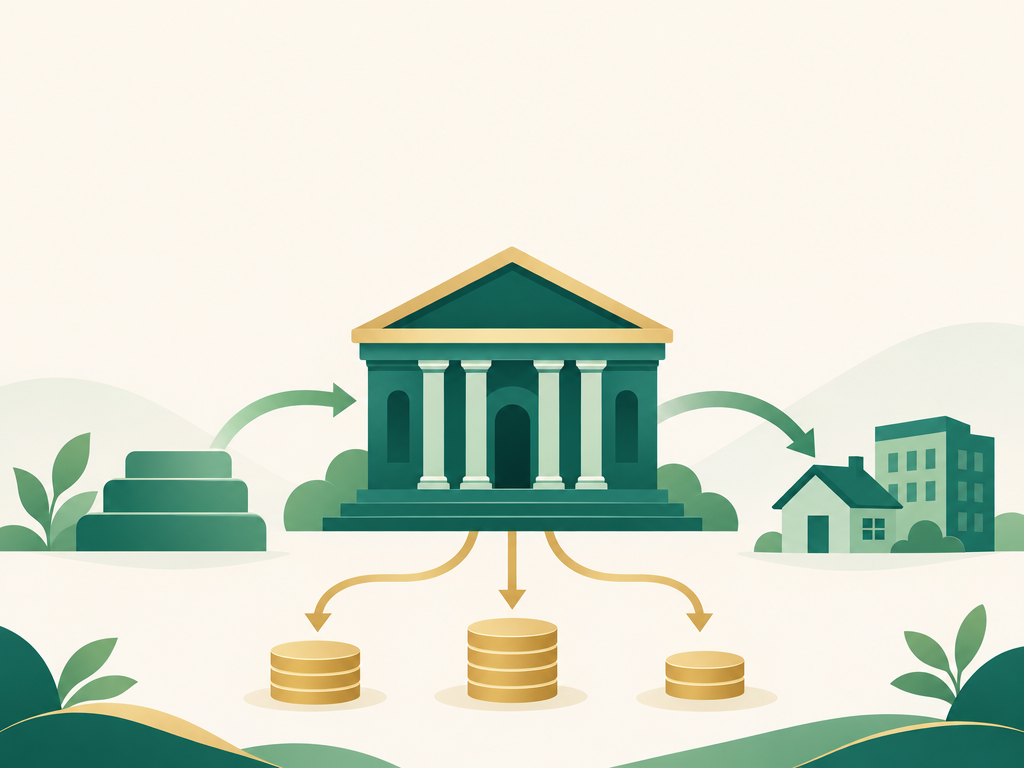
A bank works with two interest rates at once. One is what it pays people like you for keeping money in your account. The other is what it earns when it lends money out.
Think of it like a market stall that buys apples at one price and sells them at a higher price. The stall's profit is the space between those two prices. A bank does the same thing, except what it buys and sells is money.
Deposits are where the bank pays interest. Loans are where the bank earns interest. The bank lives in between.
The name for the gap: net interest income
Bankers have a name for this gap: net interest income. It sounds technical, but it's really just a subtraction.
Take all the interest the bank earns on its loans. Take away all the interest it pays out to depositors. Interest in, minus interest out. What's left over is net interest income.
Picture a bucket with a tap filling it and a small hole draining it. The tap is the interest coming in from loans. The hole is the interest going out to savers. Net interest income is whatever stays in the bucket.
Why the gap can widen when rates climb
This is the part most people never notice. When interest rates go up, you might expect your savings rate to go up by the same amount. Usually it doesn't.
In a rising rate cycle, banks don't pass all of the increase on to depositors. Depositors get only part of it. In fact, deposit rates usually rise the least of all.
Now think about the two rates again. If the rate the bank earns climbs faster than the rate it pays you, the space between them gets bigger. So the gap can widen quietly, and nobody sends you a letter about it.
Back to the market stall: imagine apple prices go up and the stall raises its selling price, but barely raises what it pays the farmer. The stall's slice gets bigger without anyone making much noise.
Fees: a separate stream
The interest gap isn't the only answer to "how do banks make money." Account fees are a separate stream of income.
In the United States, for example, banks and credit unions can charge a monthly maintenance or service fee just for having an account. That money doesn't depend on interest rates at all. It's charged for the account itself, not for lending or saving.
So a bank can have two ways of earning from the same customer: the gap on interest, and fees on the account.
Big banks and small banks don't earn the same way
Not every bank leans on the gap equally. Smaller banks generally rely on that interest gap more for their revenue.
Larger banks tend to have more different ways of making money, so the gap is one piece of a bigger pie. For a smaller bank, the gap is more of the whole meal.
That's the mechanic in a nutshell. There are two rates, the bank pays you one and charges another, and it lives in between.
Sources
Each statement in the film was checked against its own source before it was made:
- A bank's net interest income is its interest income minus its interest expense. - federalreserve.gov
- In a rising rate cycle, banks do not pass on all of the increase to depositors. - federalreserve.gov
- Domestic deposits generally get the smallest share of any rate increase. - federalreserve.gov
- Because deposit rates rise least, the gap between the two rates can widen. - federalreserve.gov
- Smaller banks rely more on that interest gap for revenue than larger banks with more diversified revenue sources. - federalreserve.gov
- A bank earns on 2 rates: what it pays depositors and what it earns on loans. - federalreserve.gov
- In the United States, banks and credit unions can charge a monthly maintenance or service fee. - consumerfinance.gov
What this is not
This is an explanation of a money mechanic, not financial advice. There are no recommendations, no products, no predictions, and no promise about what any amount of money will do. What you do with the information is your own decision.
Watch it
This post accompanies the film: How Banks Make Money: The 2-Rate Gap In Your Account
Sources checked at time of publication. Educational content only - never financial advice.